


























Views
Downloads
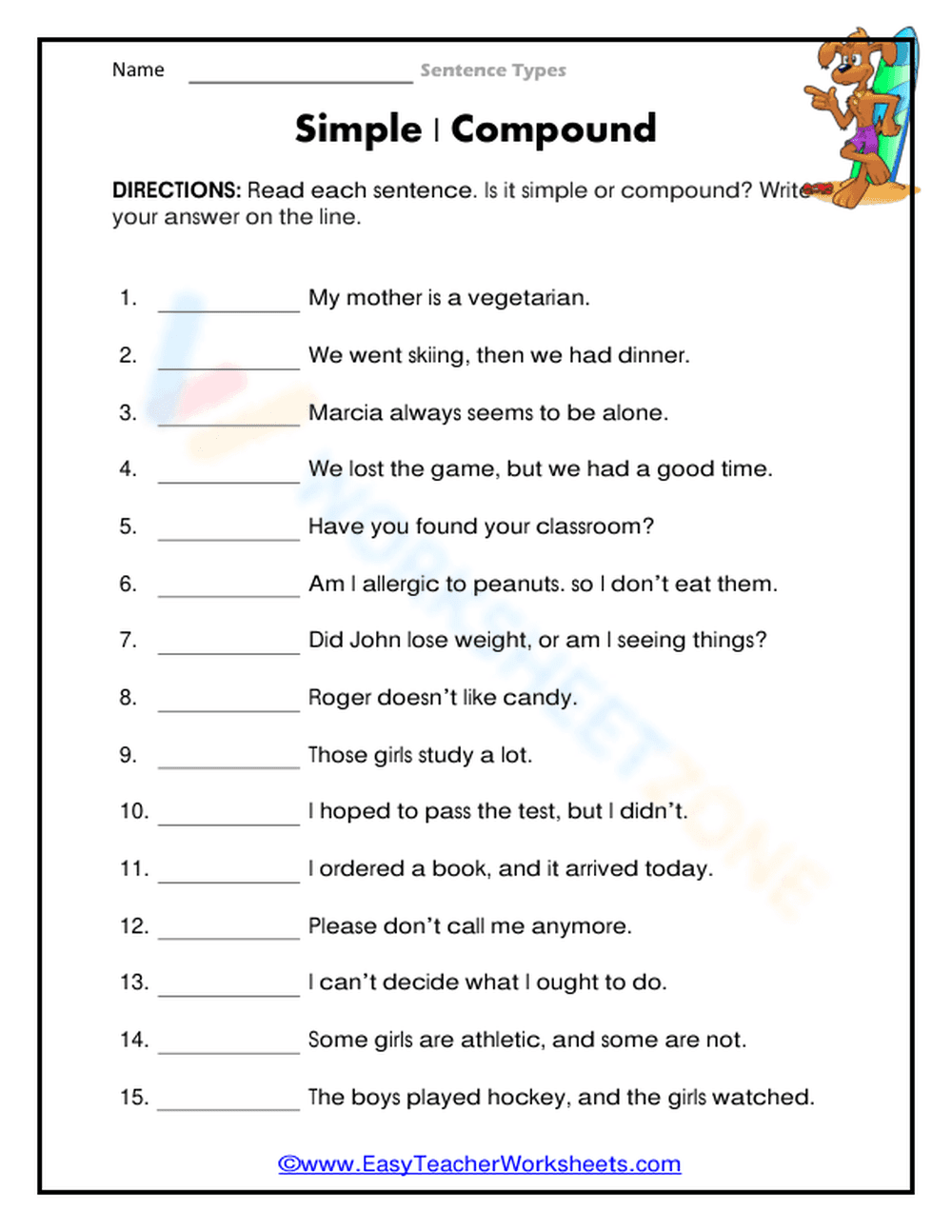

Essential Simple and Compound Sentences Worksheet | Grade 3
Paste this activity's link or code into your existing LMS (Google Classroom, Canvas, Teams, Schoology, Moodle, etc.).
Students can open and work on the activity right away, with no student login required.
You'll still be able to track student progress and results from your teacher account.
Help your Grade 3 students master the fundamentals of sentence structure with this focused ELA worksheet. By identifying the difference between simple and compound sentences, learners strengthen their grammatical foundation and improve their writing fluency. This resource provides immediate practice to ensure students can distinguish independent clauses from combined thoughts effectively.
At a Glance
- Grade: 3 · Subject: ELA
- Standard:
CCSS.ELA-LITERACY.L.3.1.I— Produce and identify simple, compound, and complex sentences for clear communication- Skill Focus: Simple vs. Compound Sentence Identification
- Format: 1 page · 15 problems · Answer key included · PDF
- Best For: Grammar review and independent practice
- Time: 15–20 minutes
What's Inside
This single-page PDF features 15 carefully curated sentences that challenge students to categorize each as either simple or compound. The layout is clean and distraction-free, featuring a "Sentence Types" header and clear instructions. Each task provides a dedicated line for student responses, making it easy to grade. A comprehensive answer key is included to facilitate quick checking or student self-correction.
Zero-Prep Workflow
This worksheet is designed for maximum efficiency in busy classrooms. Following a simple three-step workflow, you can implement this lesson in under two minutes of total teacher prep time. First, print the single-page document. Second, distribute the copies to your students. Finally, review the answers using the provided key during a whole-class check or individual conferences. It is an ideal resource for substitute plans or emergency grammar fillers.
Standards Alignment
The primary alignment for this resource is `CCSS.ELA-LITERACY.L.3.1.I`, which requires students to produce simple, compound, and complex sentences. By first mastering the identification of these structures, students build the prerequisite knowledge necessary for sophisticated writing. Both standard codes can be copied directly into lesson plans, IEP goals, or district curriculum mapping tools.
How to Use It
Use this worksheet as a formative assessment after a mini-lesson on conjunctions (FANBOYS) and sentence combining. Distribute it during independent work time to observe which students struggle to identify the comma and coordinating conjunction in compound structures. This expected completion time of 15-20 minutes makes it perfect for a "bell-ringer" activity or a quiet transition between subjects.
Who It's For
This resource is tailored for third-grade students but serves as excellent enrichment for second graders or remedial support for fourth graders. It is particularly effective for English Language Learners (ELLs) who need repetitive practice with clause structures. Pair this with a sentence-sorting anchor chart to provide visual support for struggling learners.
Grammar instruction that focuses on explicit sentence-level identification is a cornerstone of effective literacy development. According to the RAND AIRS 2024 report, students who engage in regular, structured practice with sentence variety demonstrate higher rates of syntactic maturity in their independent writing. This worksheet directly addresses the `CCSS.ELA-LITERACY.L.3.1.I` standard by requiring students to distinguish between simple and compound sentences, a skill that serves as a bridge to mastering more complex grammatical structures. Research by Fisher & Frey (2014) emphasizes that identifying sentence types is a critical step in the gradual release of responsibility model, moving students from teacher-led modeling to independent application. By providing 15 targeted problems, this resource offers the necessary volume of practice for students to achieve mastery. Early intervention in sentence mechanics prevents persistent writing deficits in later grades, making this Grade 3 resource an essential component of any ELA curriculum.


